Prewired Guitar Kits Explained: What Actually Changes When You Swap the Electronics
A plain look at what is inside a prewired harness, which parts change your sound and which do not, and how to tell when the problem is somewhere else.
Every week someone walks up to our counter with a guitar that sounds fine at ten and turns to mud the moment they roll the volume back. Sometimes the fix is a prewired harness. Sometimes it is a sixty cent jack. This post explains what actually changes when you swap the electronics, so your money goes to the right part.
What is in the box
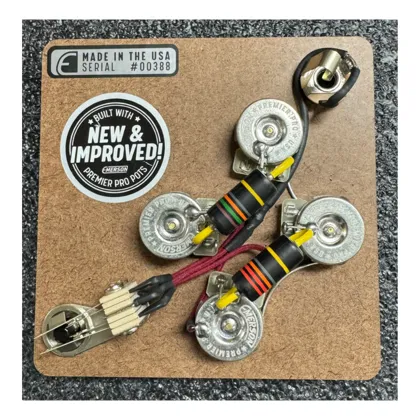
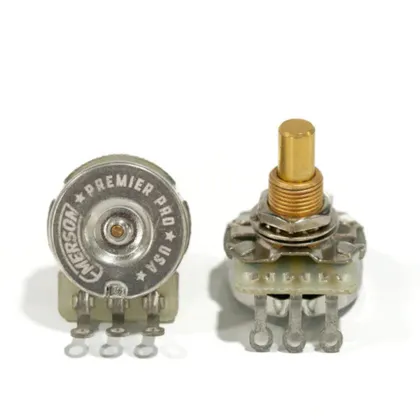
A prewired kit is the whole control circuit, already soldered together, minus the pickups. For the Emerson Custom 5-Way Strat kit, Emerson lists three Premier Pro split shaft potentiometers, an Oak Grigsby five way switch, a Switchcraft 1/4 inch mono jack already wired in, one Emerson paper in oil capacitor and what they call a Volume Mod, plus a wiring diagram. The three way Telecaster kit has two solid shaft pots, an Oak Grigsby or Centralab three way switch, a Switchcraft jack, one capacitor and 22 AWG vintage push back wire. The Les Paul kit ships four 500K pots, a Switchcraft J11 jack and two Bumblebee paper in oil caps, 0.022uf for the bridge and 0.015uf for the neck, wired 50s style and grounded with buss wire. The 335 kit uses the same four pots and two caps and is wired the same way.
So the kit replaces pots, switch, jack, caps and the wire between them. Your pickups and your control plate or pickguard stay. Your knobs usually stay too, see the fit notes below. Emerson builds these by hand in Broken Arrow, Oklahoma, and we stock the genuine kits in our Emerson Custom section.
Pot value: 250K or 500K
This is the choice that changes your sound the most, and the change is measurable. A potentiometer sits across your pickup signal, and a lower value pot bleeds more high end to ground even when it is turned all the way up. Seymour Duncan puts it plainly: 250K pots naturally attenuate more high frequencies than pots with higher ratings, and 500K pots have higher resistance, lessening their impact on high frequencies. That is why 250K is almost universally paired with single coils, and 500K with humbuckers.
Emerson follows the same logic. The Strat and Tele kits come in 250K for single coils or 500K for P90s and humbuckers, and the cap value changes with the pot value: 0.047uf with 250K, 0.022uf with 500K. If your Strat feels dull, a 500K kit will open it up. If it feels icepick bright, stay at 250K.
Audio taper or linear taper
Value is how much resistance the pot has. Taper is how that resistance is spread across the turn. Seymour Duncan describes audio taper as giving a more natural feeling and sounding swell, with many tonal shades through the range, while a linear pot feels more like an on/off switch, with a fast jump in the first quarter turn and little happening after that. Emerson's product pages treat the taper and response of their Premier Pro pots as the point of the kit. If your current volume knob does everything between eight and ten and nothing below, taper is what you are feeling, and a good harness fixes it.
What a treble bleed does
This is the mud problem from the intro. Seymour Duncan explains it well: your volume pot is a variable resistor, and as you turn it down it introduces more resistance and sends more of the signal to ground. Combined with cable capacitance the circuit acts like a low pass filter, so highs disappear faster than volume does.
A treble bleed is a small capacitor, sometimes with a resistor, wired across the volume pot so the highest frequencies skip the resistance. Seymour Duncan lists three common versions. The first is a cap only, around 1000 pF, which keeps top end but tends to roll off lows. The second is a cap with a 150K resistor in parallel, which lets highs and lows fall together but can leave an uneven sweep with a sudden drop at the end. The third is a cap in series with a resistor, roughly 1000 to 1500 pF with 100K to 330K, which keeps a familiar sweep while protecting the treble.
If you ride your volume knob for cleanup and hate that the sound goes dark, you want one. If you like the darker sound at seven for rhythm parts, or you play a Les Paul wired 50s style, you may not need it at all. Emerson's Strat and Tele kits list a Volume Mod as a component, and the Les Paul kit's 50s wiring is their answer to the same problem. Ask us which one your kit carries before you order.
Paper in oil versus film caps, honestly
The cap value is measurable and it matters. Mojotone says it directly: the higher the capacitance, the darker the overall tone, so a 0.047uf cap sounds darker than a 0.022uf cap when you roll the tone knob down.
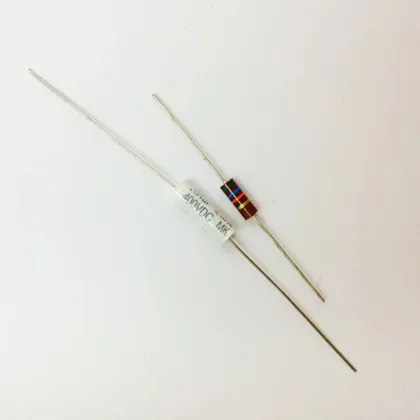
The cap type is a different story. One hobbyist test measured five caps all sold as 0.022uf. The polyester film and polystyrene parts read 22.35 nF, the ceramic 22.94 nF, the Orange Drop 21.52 nF, and the paper in oil 26.47 nF. The biggest difference between those caps was that the paper in oil part was about twenty percent above its label. That is a difference in value, and the material has nothing to do with it. Mojotone admits that measuring the frequency differences between cap types requires equipment most of us do not have, and lands where we do: let your ears decide.
Our position at the counter: with the tone knob on ten the cap is barely in the circuit, and when you roll it down, value dominates. Emerson's Bumblebee caps look right in a Les Paul cavity, and that is a fine reason to want them. We just will not tell you a paper in oil cap is going to change your life.
50s versus modern Les Paul wiring
This one is real and it is the reason people buy the Les Paul and 335 kits. The only physical difference is where the tone cap connects. In 50s wiring, per Seymour Duncan, the outer lug of the tone pot connects to the middle lug of the volume pot through the 0.022uf cap. In modern wiring the tone pot hangs off the outer lug of the volume pot, where the pickup's hot lead lands.
The result: 50s wiring keeps more high end as you turn the volume down and the two knobs become highly interactive, so turning the tone down also costs you some volume. Modern wiring keeps volume more consistent when you roll back but loses some treble. Emerson wires their Les Paul, SG and 335 kits 50s style, which they describe as a smoother feeling volume pot with less treble loss and interactive controls. If you live on the volume knob, that is what you want.
What installation involves
On a Strat or Tele the harness comes spaced to fit. Emerson builds the Tele kit for standard USA Fender control plates with 2.50 inches center to center between volume and tone, and the 335 kit is spaced 68.5 mm neck and 65.5 mm bridge, which will not fit a 339. Measure before you buy. On a Les Paul you choose 3/4 inch long shaft for carved tops or 3/8 inch short shaft for flat tops.
The soldering itself is limited. You typically solder the pickup leads and the bridge ground wire to the harness, and on some kits the jack. StewMac's advice is simple: a 40 watt pencil is enough, use 60/40 rosin core solder in the .032 to .062 inch range, tin the wire and the lug first, then heat the joint and let the solder flow in. Do not blow on it to cool it. Premier Guitar's guide lands in the same place with a 25 to 60 watt iron.
The tools we would put on the bench:
- A 25 to 40 watt soldering iron with a stand and a damp sponge.
- 60/40 rosin core solder.
- Wire cutters and a small wire stripper.
- Needle nose pliers.
- A multimeter, for reasons below.
- A nut driver or deep socket for the pot nuts, and a jack wrench if you have one.
Two fit notes that catch people. Emerson's split shaft pots are cut for USA spec 24 spline push on knobs, and some guitars, including some US built ones, use import parts that will not fit. Import guitars may also need the pot holes reamed to take the larger US pots. Neither is hard, but check both before the old harness is out.
When a kit is the wrong fix
A harness fixes scratchy pots, bad taper, a cheap switch, a broken solder joint you cannot find, and the treble loss problems above. It does not fix a dead pickup or a ground problem outside the control cavity.
Before you order anything, do what Seymour Duncan recommends and put a multimeter on it. Set it to ohms, plug in a cable, select one pickup with the volume up, and touch the probes to the tip and sleeve of the cable. Compare the reading to the pickup manufacturer's spec. If one pickup reads wildly off or open, the pickup is broken and a new harness will not bring it back.
Then switch the meter to continuity and touch one probe to a string and the other to the sleeve of the jack. A clear beep means the ground path is good. Silence means a broken ground wire, often at the bridge or the tailpiece, and a harness does not fix that.
Finally, wiggle the cable in the jack while playing. If the sound cuts in and out, the jack is worn. Emerson's kits include a Switchcraft jack, but if only the jack is bad, buy the jack.
If the pickups read right and the ground beeps, and the guitar still feels wrong, that is when the kit earns its price. We keep the Strat, Tele, Les Paul and 335 versions on the shelf. If you are not sure which pot value or shaft length fits your guitar, send us the model and we will tell you before you check out at our shop.
Sources
- https://emersoncustom.com/collections/prewired-kits
- https://emersoncustom.com/products/s5-5-way-strat-prewired-kit
- https://emersoncustom.com/products/3-way-telecaster-prewired-kit
- https://emersoncustom.com/products/les-paul-prewired-kit
- https://emersoncustom.com/products/335-prewired-kit
- https://www.seymourduncan.com/blog/latest-updates/how-to-find-the-right-pots-for-your-guitars
- https://www.seymourduncan.com/blog/latest-updates/3-popular-treble-bleed-mods-what-you-need-to-know
- https://www.seymourduncan.com/blog/tips-and-tricks/lespaulwiring
- https://www.seymourduncan.com/blog/latest-updates/how-to-test-guitar-pickups-with-a-multimeter
- https://www.seymourduncan.com/blog/latest-updates/how-a-multi-meter-can-help-your-guitar
- https://mojotone.com/blogs/news/tone-capacitors
- https://nicktgr15.github.io/testing-different-types-of-guitar-tone-capacitors-orange-drop-vs-paper-in-oil-vs-polystyrene-vs-polyester-vs-ceramic.html
- https://www.stewmac.com/video-and-ideas/online-resources/learn-about-guitar-pickups-and-electronics-and-wiring/soldering/
- https://www.premierguitar.com/diy/guitar-bass-mods/guitar-soldering
![4-Way Lever Switch (Oak Grigsby) [EP-4374]](/assets/thumb/4-way-lever-switch-oak-grigsby-ep-4374-0.webp)