Titanium Guitar Saddles and Neck Reinforcement Bars: What the Material Actually Does
We explain what titanium does and does not do in guitar saddles and neck reinforcement bars, with sourced material numbers and fit checks.
Why we wrote this
People call the counter asking whether titanium saddles will "fix" their tone. We stock KTS Titanium parts, so we have a commercial interest here, and that is exactly why we want to be careful. The honest answer is that titanium changes a few things you can measure and a few things you can only hear for yourself. This post separates the two.
The material, in numbers
KTS makes its parts from titanium. Its Floyd Rose insert blocks are described as "pure titanium," and the neck bars are cold rolled titanium. KTS does not publish a grade for every part, so we will give you the two common reference points and let you place the parts between them.
Commercially pure Grade 2 titanium has a density of 4.51 g/cm3 and an elastic modulus of about 105 GPa. The alloy Ti-6Al-4V (Grade 5) sits at 4.42 to 4.43 g/cm3 with a modulus of roughly 105 to 120 GPa; most tables quote 114 GPa. For comparison, carbon steel is 7.85 g/cm3 at 200 GPa, stainless is 7.5 to 8.0 g/cm3 at 193 GPa, and brass is around 8.4 to 8.73 g/cm3 depending on the alloy, with a modulus near 110 GPa.
Two plain conclusions come out of that. First, a titanium part is a little over half the weight of the same part in steel and roughly half the weight of one in brass. Second, titanium is a good deal less stiff than steel per unit of cross section, and about the same stiffness as brass. The word "strong" gets thrown around, but stiffness and strength are different properties. Ti-6Al-4V has a tensile strength of 895 MPa or more, which is where the "strong" reputation comes from. Grade 2 is much softer at 345 to 515 MPa.
Corrosion is the least debatable point. Pure titanium forms an oxide layer that passivates it, and if the surface is scratched the exposed metal oxidizes again on its own. Ti-6Al-4V is rated highly resistant to general corrosion in sea water. That matters on a bridge because sweat is a salt solution and a plated steel saddle loses its plating at exactly the point where the string bears on it.
Why saddle material is argued about
A saddle does two jobs. It sets the string's end point, and it is the first piece of metal the string's vibration has to pass through on its way to the body. Anything that changes its mass or how it damps vibration will change something, and the debate is about how much of that something reaches your ear once the pickup and the rest of the signal chain have had their say.
KTS's own position is that titanium has a "low internal damping rate" and that this leads to "a good sound rise" and "long sustain, immediate attack response, and a clear and defined sound." We are not going to repeat that as fact. Internal damping in metals is a real, measurable property, but nobody we know has published a controlled measurement of a titanium versus steel saddle on a guitar with everything else held constant. Until someone does, the sonic part is opinion, including ours.
Here is what you can measure with a scale and a magnet. A set of titanium saddles weighs less than the steel set it replaces. The surface does not rust, and there is no plating to wear through. On a Floyd Rose, the insert block is a small part that gets crushed by a clamp screw tightened too far; KTS says its block exists to prevent "breakages inside of saddle usually occurring due to overly tightened screws or corrosion." Those are durability arguments, and they hold up without any tone claim attached.
What you cannot measure at home is whether the attack sounds quicker or the highs sound clearer. Some players swear by it. Others swap a set and hear nothing. We do not think either group is lying.
Where titanium saddles are actually used
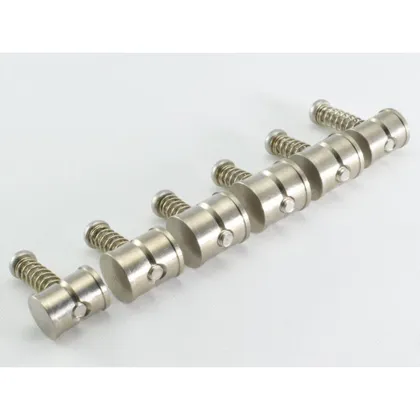
Most of what we sell is pressed, vintage style saddle sets for Strat and Tele bridges, plus the Floyd Rose inserts.
For Strats, KTS lists three spacings: PR-04 at 2 1/8", PR-11 at 2 7/32" for USA style synchronized tremolos, and PR-15 at 2 1/16" in the offset style. The PR-11 saddle itself measures .827" long, .445" wide and .217" tall. For Tele style bridges, KTS offers the PR-08 standard set of three saddles, the PR-08WD slanted set and the PR-08 Quattro '68 style set.
For locking tremolos, KTS makes the Ti-Block-F for Floyd Rose style saddles and the Ti-Block-G for the Gotoh GE1996T. They replace only the small string lock block inside each saddle. The saddle stays.
What a titanium neck reinforcement bar is for
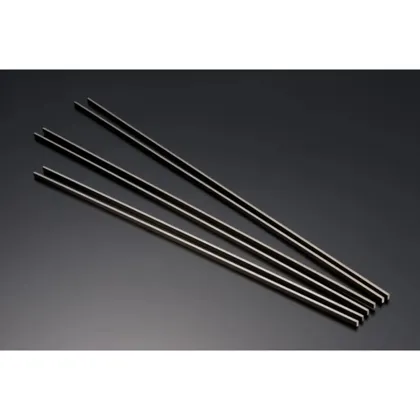
Most players have never seen this part, because it lives inside the neck. The KTS bar is a cold rolled titanium strip, 6 mm by 3 mm in section, sold in pairs: 450 mm for guitar and 550 mm for bass. KTS's instructions place one on each side of the truss rod, and the stated job is "to reduce the deformation of the neck due to string tension or environmental changes, or to stabilize the movement of the neck when the truss rod is adjusted."
Note what KTS is not saying. It does not say the bar makes a neck stiffer than a steel bar of the same size would. Given the modulus numbers above, a steel bar of the same section would in fact resist bending more. What the titanium bar offers a builder is a different trade. It weighs about 57 percent of an equivalent steel bar and it will not rust inside a sealed slot. KTS also describes it as having "adequate rigidity and flexibility," meaning the bar is meant to return to shape rather than hold a set. Michael Tobias of MTD, who uses the bars, is quoted by KTS as saying the neck feels "more solid but much more alive." Again, that is one builder's impression. Nobody has measured it. Ibanez, Atelier Z and Vance Custom Guitars are also listed as users.
The practical reason a luthier reaches for titanium over carbon fiber or steel is usually weight balance on a long scale bass neck. If you are not building an instrument or replacing its neck, this part is not for you.
Installation and compatibility checks
Saddles are only an upgrade if they fit. Run these checks before you order.
- Measure your string spacing at the bridge. Measure from the center of the low E to the center of the high E at the saddles. Match that to 2 1/16", 2 1/8" or 2 7/32" for the KTS Strat sets. Even a small mismatch shows up as the outer strings drifting toward the fret ends.
- Check the saddle style. Pressed vintage style saddles and block saddles have different heights and screw positions. The KTS Strat sets are pressed saddles. If your bridge has block saddles, the intonation screw length and the height screws may not carry over.
- The material does not change your radius. On a Strat or Tele you set radius with the two height screws per saddle, so your setup routine stays the same. On a Floyd Rose, radius is set with shims under the saddles; the Original ships at a 10" radius with a shim and reads 12" with the shim removed, and Floyd Rose sells saddle sets in 8", 10", 12", 14", 16" and 17" for the Original, 1000 Series and Special. A KTS insert block does not change any of that, but make sure any shim sits fully under the saddle or the saddle can tilt as you tighten it.
- Floyd Rose insert blocks: check the year of your saddles. Floyd Rose moved its Original saddles from casting to CNC in 2021, which added a corner radius inside the saddle box. KTS says the older square Ti-Block leaves "a small gap between the block and the saddle" on those, and released a "New Ti-Block" with rounded corners in the autumn of 2021 that fits both. Special and 1000 Series (excluding Pro) saddles and older Originals take either version.
- Neck bars need a router and a plan. The bar is 6 mm wide and 3 mm thick, so it needs its own slot on each side of the truss rod channel. This is a job for the build stage. It cannot be added to a finished neck without pulling the fingerboard.
Who should not bother
If your saddles are not rusting, or if you are chasing a specific tone problem, we would rather you spend the money somewhere else. A pickup swap or a proper setup will change your sound more reliably than any saddle material. The same goes for the neck bar: unless you are building a neck, leave it.
The players who tend to be happy with titanium are the ones whose plated saddles keep corroding under a sweaty right hand. Floyd Rose owners who have crushed an insert block once and do not want to do it again are the other group. For builders, the appeal is a lighter reinforcement bar that will never corrode inside the neck. If that is you, the KTS range is on our shelf at the KTS Titanium category, and everything else we carry is in the shop. Bring your measurements and we will confirm fit before anything ships.
Sources
- https://k-t-s.com/en
- https://k-t-s.com/en/collections/stratocaster-style-saddles
- https://k-t-s.com/en/collections/telecaster-style-saddles
- https://k-t-s.com/en/collections/string-lock-insert-for-floyd-rose-style-tremolo
- https://k-t-s.com/en/blogs/news/floyd-rose-new-kts-ti-block
- https://k-t-s.com/en/pages/kts-neck-support-rods
- https://k-t-s.com/products/kts-titanium-neck-reinforcement-bar
- https://reverb.com/item/689813-kts-titanium-pr-11-upgrade-saddle-set-for-usa-mim-fender-stratocaster-2-3-16
- https://www.azom.com/article.aspx?ArticleID=1547
- https://www.azom.com/article.aspx?ArticleID=9299
- https://tmstitanium.com/page/grade-2-titanium
- https://amesweb.info/Materials/Modulus-of-Elasticity-Metals.aspx
- https://matmake.com/properties/density-of-common-materials.html
- https://www.machinemfg.com/density-table-of-metals-iron-steel-brass-aluminum-alloys/
- https://www.floydrose.com/blogs/news/american-made-original-saddle-sets-with-radius-options
- https://hazeguitars.com/blog/setting-saddle-radius-on-the-floyd-rose